Java
For Starry Night to function, the team used two pieces of original software. The first was a set of Perl scripts that would sort the messages by their keywords and determine how bright a star should be by recording every time someone viewed that star. The other was a Java applet, an application that used the keywords found and sorted in Perl so the constellations could be generated. Even archives need to be archived, seeing as the Rhizome preservation team had to find a way to get Starry Night up online again. Led by Dragan Espenschied, the team needed a software environment so the aforementioned Java applet could be read. They also had to replicate the original application programming interface (API) that made Textbase (the archive) readable, the original API being software that no one was sure how it looked. Most of the archived content was recovered because there was material in a similar art project, Martin Wattenberg's Spiral. Since the new API isn't one-to-one with the original software, some messages are lost, meaning there are supposed to be more stars (about 2,000).
How it works
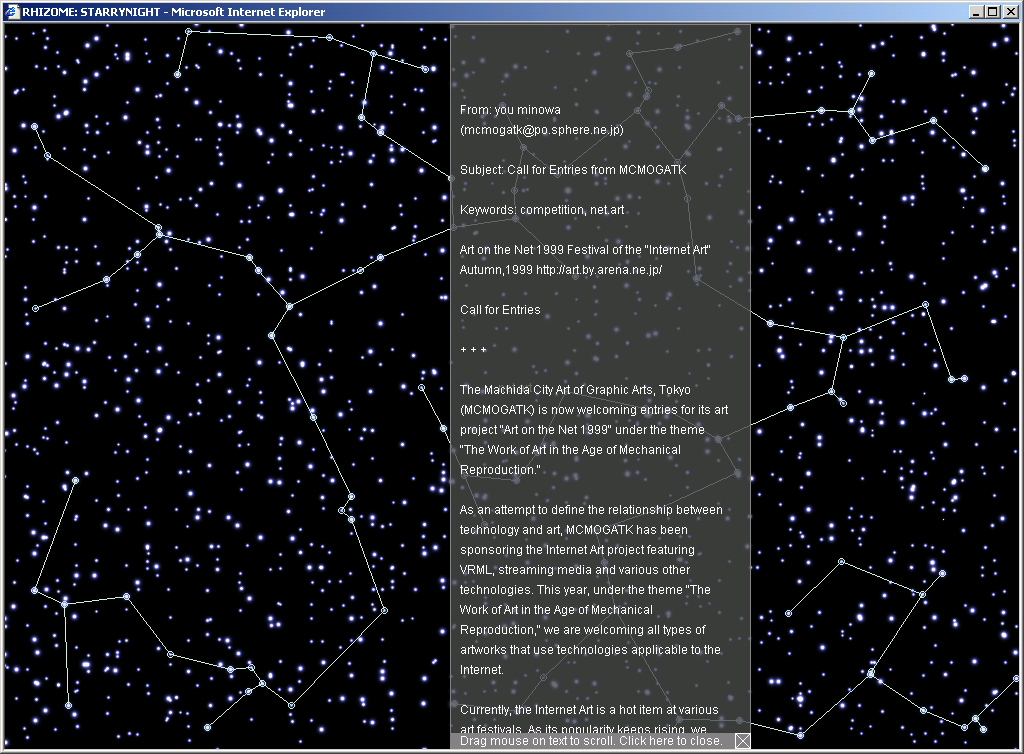
When a visitor would access an email on Rhizome’s web-based archive, a dot would appear on the black background of StarryNight. With each subsequent visit, it would grow slightly brighter.
How to interact
Users could click a given star, triggering a pop-up menu. They could opt to read the message, which would cause it to appear onscreen, or select a keyword associated with the text.